Where to Find Petoskey Stones in Michigan
These unique treasures can be elusive to first-time stone seekers, but the tips below can help get you on track to your first discovery!

Quick Tips
- Best time to go: spring and post-storm
- Top locations: Charlevoix, Petoskey, Sleeping Bear Dunes, Frankfort
- What to bring: Small bucket or bag, patience, water shoes
- Know the rules: Maximum 25 pounds per year (statewide); no collecting in national parks
- Bonus: Look out for rare, pink-colored Petoskey stones!
Quick Tips
- Best time to go: spring and post-storm
- Top locations: Charlevoix, Petoskey, Sleeping Bear Dunes, Frankfort
- What to bring: Small bucket or bag, patience, water shoes
- Know the rules: Maximum 25 pounds per year (statewide); no collecting in national parks
- Bonus: Look out for rare, pink-colored Petoskey stones!
Michigan’s Fossilized Treasures
The Petoskey stone, Michigan’s state stone – and its lesser-known cousin, the Charlevoix stone – are unique to the Great Lakes and can be found along the shores of Michigan’s lower peninsula.
Where’s the best place to find Petoskey Stones?
That’s the age-old question: Where’s the best place to find Petoskey and Charlevoix stones? Whether you’re in Charlevoix or Petoskey or elsewhere on Lake Michigan, it’s not unusual to see people strolling along the shoreline looking for these beautiful natural fossils. With numerous public beaches, rock hounds are guaranteed to find a treasure or two. Below are some popular rock hunting destinations with potential for Petoskeys. Some areas may prohibit the removal of stones. Be sure to research the rules before your quest for the perfect Petoskey stone!
Charlevoix
- Mt. McSauba
- Lake Michigan Beach
- Beaver Island
- Fisherman’s Island State Park
- North Point Nature Preserve
Petoskey
Frankfort
Leelanau County
Manistee
Tips for Finding Petoskey Stones
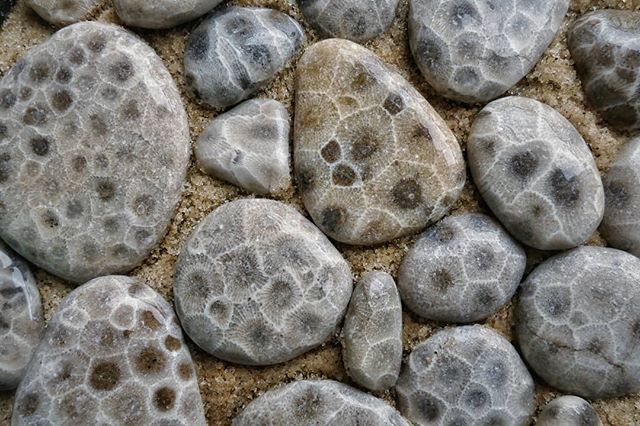
- Look for rocky, uncrowded beaches: Find a stretch of Lake Michigan beach that is uncrowded and somewhat rocky. Though there can be exceptions, your best chance at finding these fossils is in the presence of other stones. TIP: Storms and high winds can churn up the lake and can provide great stone deposits, but can also clear the beach of stones.
- Be patient: You could spend an hour walking along the shoreline of Lake Michigan and only find a few Petoskey or Charlevoix Stones. Don’t be frustrated. Rock hunting requires lots of patience. With each stone you find, it becomes easier to identify the next one. Plus, when you’re walking a Lake Michigan beach, the view is usually pretty nice, too.
- Know the rules: When hunting rocks of any kind, it’s extremely important to be aware of any state or federal regulations. According to the Michigan DNR, you are only allowed to remove 25lbs of stones per year. If any Petoskey Stone weighs over 25lbs, the DNR has the right to confiscate it. If you’re strolling the shores of Sleeping Bear Dunes National Lakeshore for your search, keep in mind that stones must remain where you find them. The National Park Service invites visitors to find and admire Petoskey stones and other natural treasures on its Lake Michigan beaches, but asks that they be returned to the lake to maintain the pristine nature of the environment.
- Best times to hunt for Petoskey stones: The spring is generally the best time of year to find Petoskey stones because wave action and winter’s ice have brought new stones to the shores of Lake Michigan. Heading out in the rain or right after a storm can be productive times, too.
Other tips:
- Carry a small bucket or bag to collect your treasures.
- Keep an eye out for the rare “Pink Pets” Petoskey Stones. The pink hue is a result of the iron that permeated the coral as it calcified.
- And in case you’re interested before you go, here’s, a little background…
What is a Petoskey Stone?
The Petoskey stone is fossilized pre-historic coral fossilized rugose coral, Hexagonaria percarinata. Distinguishable by its unique exoskeleton structure, a Petoskey stone consists of tightly packed, six-sided corallites, which are the skeletons of the once-living coral polyps. The center of each polyp was the mouth and contained tentacles that reached out for food. The hexagon shape of each cell and thin lines radiating out from the dark “eye” in the center are distinguishing features unique to this fossil.
Petoskey vs. Charlevoix Stones: What’s the Difference?
- Though similar, the Charlevoix stone is distinguishable by its:
- Smaller, tighter-packed coral structure
- More honeycomb-like appearance
- Rarity – It’s slightly harder to find than the Petoskey stone
Do you have a favorite beach for hunting and finding Petoskey stones? Share your photos with us by using #PureMichigan. Happy hunting!